


 News & Tips
What Is a PQF Level?
A PQF Level is a level within the Philippine Qualifications Framework (PQF) that describes the expected learning outcomes, knowledge, skills, application, and degree of independence associated with a qualification in the Philippines.
The PQF was institutionalized through Republic Act No. 10968, also known as the PQF Act, which establishes the Philippine Qualifications Framework, creates the PQF-National Coordinating Council, and provides the legal foundation for a nationally coordinated system of qualifications.
The Philippine Qualifications Framework provides a common reference for understanding qualifications earned through different parts of the Philippine education and training system. It helps explain how qualifications from basic education, technical-vocational education, higher education, and professional regulation relate to nationally recognized standards.
The official PQF describes itself as a quality-assured national system for the development, recognition, and awarding of qualifications based on standards of knowledge, skills, and values acquired through different learning methods. It is intended to help learners, workers, professionals, employers, educational institutions, and government agencies understand and compare qualifications.
Understanding the PQF is particularly useful if you are a student, graduate, licensed professional, career shifter, employer, trainer, or Filipino professional planning to work or study abroad.
This article explains the 8 PQF Levels, their corresponding qualifications, how RA 10968 supports the framework, and why the PQF matters to Filipino professionals.
Why Was the Philippine Qualifications Framework Created?
Before the PQF, different parts of the Philippine education and training system operated with their own terminology, standards, qualifications, and progression pathways.
For example, technical-vocational education uses qualifications such as National Certificates, while higher education awards associate degrees, bachelor’s degrees, master’s degrees, and doctoral degrees. Professional regulation adds another important dimension through licensure examinations and professional registration.
The PQF provides a common national reference for these different qualifications.
According to the official PQF, its objectives include adopting national standards and levels of learning outcomes, supporting pathways and equivalencies between education and training sectors, and aligning Philippine qualification standards with international qualification frameworks.
This has several important benefits.
1. It creates a common language for qualifications
A qualification can be understood not only by its title but also by the level of learning outcomes associated with it.
2. It supports education and career pathways
The framework helps establish pathways between different sectors of education and training and between education and employment.
3. It supports worker mobility
The PQF helps make Philippine qualifications more understandable and comparable, which is important when Filipino professionals seek employment or further education in other countries.
4. It promotes quality assurance
Qualifications included within the framework are associated with standards and quality-assurance processes.
5. It helps employers understand qualifications
Employers can use qualification information to better understand what knowledge, skills, and capabilities a person is expected to possess.
Understanding the 8 PQF Levels
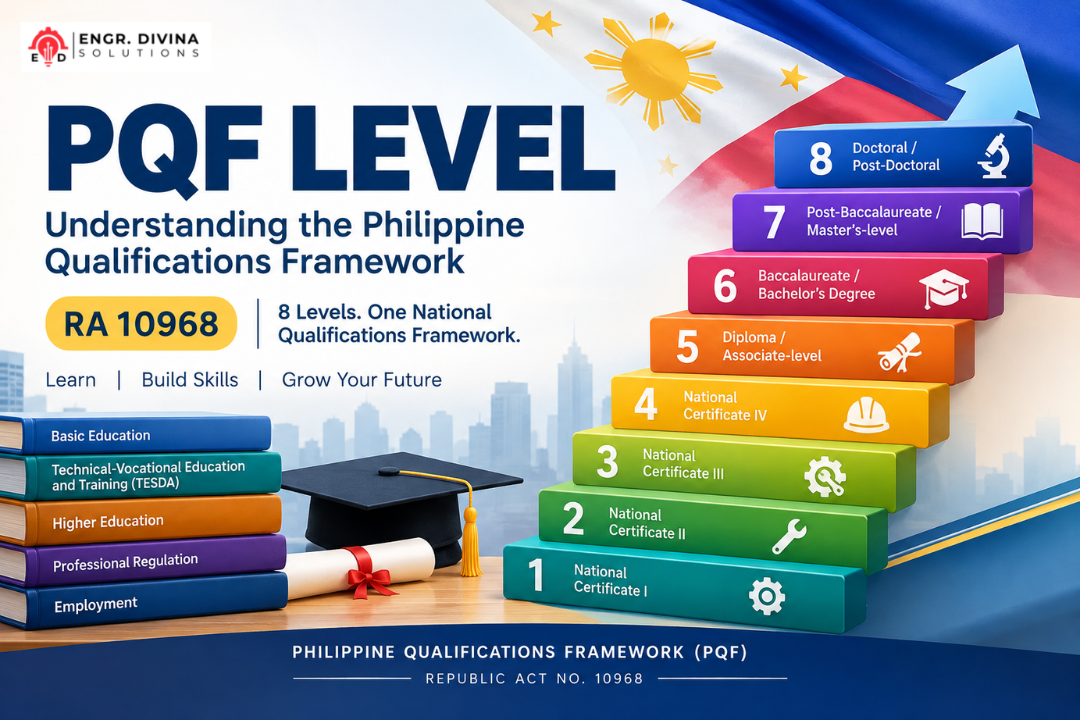
The Philippine Qualifications Framework contains eight levels of qualifications.
Each PQF Level is differentiated through descriptors covering three major areas:
- Knowledge, skills, and values
- Application
- Degree of independence
The official PQF identifies eight levels and provides corresponding qualification types across the Philippine education and training system.
A simplified view is:
| PQF Level | General Qualification |
|---|---|
| Level I | National Certificate I |
| Level II | National Certificate II |
| Level III | National Certificate III |
| Level IV | National Certificate IV |
| Level V | Diploma / Associate-level qualifications |
| Level VI | Baccalaureate / Bachelor’s Degree |
| Level VII | Post-Baccalaureate / Master’s-level qualifications |
| Level VIII | Doctoral / Post-Doctoral qualifications |
The framework also incorporates basic education qualifications, including the Junior High School Certificate and Senior High School Diploma, within the overall eight-level structure.
It is important to remember that a PQF Level is not simply a ranking of a person’s intelligence, job position, or salary. Instead, it describes the expected outcomes and level of competence associated with a formal qualification.
PQF Level I: Foundational Technical and Practical Skills
PQF Level I represents an introductory level of qualification.
At this level, knowledge and skills are generally practical, operational, manual, or concrete in nature. Activities are normally performed in familiar and predictable situations and may involve following established rules, procedures, or instructions.
The level is associated with qualifications such as National Certificate I (NC I) within the technical-vocational education and training system.
A person holding a qualification at this level has demonstrated specific competencies appropriate to the qualification. Work may generally require close supervision, guidance, or support.
For individuals entering technical-vocational education, Level I can represent an important starting point for developing occupational skills.
The significance of this level is that it recognizes practical competence as a formal qualification rather than treating academic education as the only pathway to recognized skills.
PQF Level II: Developing Occupational Competence
PQF Level II is associated with National Certificate II (NC II) qualifications.
NC II is particularly familiar to Filipinos because TESDA qualifications are widely used across numerous industries, including construction, electrical work, electronics, automotive, information and communications technology, hospitality, agriculture, and other occupational fields.
At this stage, a learner demonstrates practical knowledge and skills applicable to familiar and predictable work situations.
The individual is expected to perform tasks according to established procedures and standards.
For many workers, an NC II qualification can be an important entry point into employment or further technical training.
However, having a PQF Level II qualification does not mean that a person is automatically qualified for every job in an occupational field. The actual scope of work depends on the qualification, competency standards, employer requirements, applicable laws, and industry regulations.
PQF Level III: Broader Technical Competence
PQF Level III corresponds to National Certificate III (NC III).
At this level, the worker is expected to handle a broader range of familiar and predictable situations and may need to select from different established rules, procedures, or methods.
Compared with lower levels, there is greater expectation of judgment in addressing routine work issues.
This distinction is important.
The PQF does not merely ask whether someone has learned a particular task. It considers how the individual can apply knowledge and skills within different situations.
As competence develops, the individual generally gains greater ability to identify problems, select appropriate procedures, and perform work with less direct supervision.
PQF Level IV: Advanced Technical and Supervisory Capability
PQF Level IV is associated with National Certificate IV (NC IV).
This level represents a higher degree of technical and practical competence.
The official PQF describes Level IV knowledge and skills as involving a balance of theoretical or technical and practical knowledge. Work may involve understanding processes, contributing to problem solving, and making decisions concerning processes, equipment, and materials.
At this level, activities may include unfamiliar or unpredictable aspects.
The worker may need to interpret and apply established guidelines or procedures while making appropriate variations.
There may also be individual responsibility or autonomy and some responsibility for other people. Team participation and coordination may become increasingly important.
This is one reason why PQF Levels are useful for employers: the framework gives a broader indication of the complexity of expected competence rather than relying solely on the name of a certificate.
PQF Level V: Diploma and Bridging Qualifications
PQF Level V occupies an interesting position within the Philippine qualifications system because it can serve as a bridge between technical-vocational education and higher education.
The official PQF information identifies Level V with qualifications such as Diploma and certain associate-level qualifications.
At this level, knowledge can be more theoretical or abstract and may have significant depth in one or more areas.
A person operating at this level may be expected to address non-routine issues, interpret guidelines, adapt procedures, and provide some leadership or guidance.
This bridging function is important because education does not always follow a single straight path.
A learner may begin with technical-vocational training, gain occupational experience, pursue additional education, and eventually move into higher-level qualifications.
The PQF supports the idea that learning and competency can develop through different pathways.
PQF Level VI: Bachelor’s Degree and Professional Qualifications
PQF Level VI is one of the most familiar levels for Filipino professionals because it corresponds to the baccalaureate or bachelor’s degree.
Under the PQF, undergraduate education is positioned at Level VI.
Graduates are expected to demonstrate broad and coherent knowledge and skills in their field, apply knowledge in professional or creative work or research, and work with substantial independence or as part of teams with minimal supervision.
This level is especially important for regulated professions.
For professions regulated by the Professional Regulation Commission, the relevant licensure examination and professional registration requirements are additional considerations. The official PQF explains that for disciplines regulated by PRC, passing the applicable licensure examination is an additional requirement associated with professional practice.
This distinction is extremely important:
A bachelor’s degree and a professional license are not necessarily the same thing.
A person may graduate from a bachelor’s degree program but still need to pass a licensure examination and obtain professional registration before legally practicing a regulated profession.
For example, engineering, accountancy, nursing, medicine, architecture, and many other professions have their own professional regulatory requirements.
Therefore, PQF Level VI describes the qualification level, while professional practice may require additional regulatory requirements.
PQF Level VII: Advanced and Specialized Professional Knowledge

PQF Level VII represents post-baccalaureate qualifications, including master’s-level qualifications.
At this level, learners are expected to demonstrate advanced knowledge and skills in a specialized or multidisciplinary field.
The application of knowledge can involve professional practice, research, leadership, and self-directed work.
The degree of independence is also substantially higher.
A Level VII graduate may be expected to take initiative, lead professional activities, conduct research, solve complex problems, and work effectively within specialized or multidisciplinary environments.
Master’s-level education can therefore be valuable for professionals who want to deepen specialization, transition into research or academic work, take on leadership responsibilities, or develop advanced expertise.
However, a master’s degree is not automatically required for every senior position. Job requirements vary by industry, organization, profession, and role.
PQF Level VIII: Doctoral and Post-Doctoral Qualifications
PQF Level VIII represents the highest level of the Philippine Qualifications Framework.
It covers doctoral and post-doctoral qualifications.
At this level, individuals are expected to demonstrate highly advanced and systematic knowledge and skills in highly specialized or complex multidisciplinary areas.
The application of knowledge can involve advanced research, professional leadership, innovation, development, and management.
The expected degree of independence is also very high.
Level VIII work can involve strategic leadership, research creativity, advanced problem solving, and significant expertise-based autonomy and accountability.
Doctoral education therefore goes beyond simply completing more coursework.
Its purpose generally involves generating, advancing, applying, or critically evaluating knowledge at an advanced level.
PQF Level Is More Than a Number
One common misunderstanding is to treat the PQF as simply an eight-step ranking system.
That is not the best way to understand it.
A PQF Level describes the complexity and expected outcomes of a qualification.
The framework considers:
- What knowledge does the learner possess?
- What skills can the learner demonstrate?
- How can those skills be applied?
- How complex are the situations that can be handled?
- How much supervision is required?
- How independently can the individual work?
- Can the individual lead or coordinate others?
- Can the individual conduct advanced research or professional practice?
Consequently, two people may have different qualifications and different PQF Levels while both contributing valuable skills to an organization.
The PQF recognizes different forms and levels of learning rather than defining professional value solely by academic titles.
How RA 10968 Strengthens the PQF
Republic Act No. 10968 institutionalized the Philippine Qualifications Framework through legislation.
The law is formally titled:
“An Act Institutionalizing the Philippine Qualifications Framework (PQF), Establishing the PQF-National Coordinating Council (NCC) and Appropriating Funds Therefor.”
The law provides the legal foundation for coordinating the Philippine qualification system.
The PQF is implemented through cooperation among major government agencies involved in education, training, professional regulation, and employment.
The official PQF identifies the participating agencies as:
- Department of Education (DepEd)
- Technical Education and Skills Development Authority (TESDA)
- Commission on Higher Education (CHED)
- Professional Regulation Commission (PRC)
- Department of Labor and Employment (DOLE)
Together, these agencies help establish a coordinated national approach to qualifications.
Why PQF Matters to Filipino Students
For students, understanding the PQF can help clarify where a qualification fits within the broader Philippine education system.
Instead of looking only at the name of a course or certificate, students can ask:
What qualification does this program lead to?
What PQF Level does that qualification correspond to?
What further education pathways are available?
What employment opportunities recognize this qualification?
This is particularly useful when comparing technical-vocational programs, diploma programs, bachelor’s degrees, postgraduate programs, and professional qualifications.
The framework can also help students understand that there are multiple legitimate pathways toward career development.
Why PQF Matters to Professionals
For working professionals, the PQF can help provide a common language for describing qualifications.
This can be especially useful when preparing:
- Resumes
- Professional profiles
- Job applications
- Training records
- Academic applications
- Professional recognition documents
- International employment applications
- Credential evaluation documents
For Filipino engineers, IT professionals, electronics professionals, technicians, managers, and other specialists, understanding the relationship between education, certification, professional registration, and competency can make career documentation clearer.
The PQF is particularly relevant when professionals need to demonstrate that their qualifications meet recognized national standards.
PQF and International Recognition
One of the important objectives of the PQF is to improve the comparability and recognition of Philippine qualifications internationally.
The framework is designed to align domestic qualification standards with international qualifications frameworks and support the mobility of Filipino students and workers.
This does not mean that a PQF Level automatically guarantees employment or professional licensure in another country.
Foreign countries have their own laws, professional registration systems, immigration requirements, credential evaluation processes, and employer standards.
Instead, the PQF provides a structured reference that can make Philippine qualifications easier to understand and compare.
For professionals planning to work overseas, this distinction is important.
A qualification framework can support recognition, but it does not replace the receiving country’s regulatory requirements.

Philippine Qualifications Register and PQF Level
The Philippine Qualifications Register (PhQuaR) is another important component of the PQF system.
The PhQuaR serves as a national database of quality-assured qualifications authorized under the Philippine Qualifications Framework.
It provides information such as the qualification title, qualification descriptors, PQF Level, authority-granting agency, qualification code, and authorization information.
The official PhQuaR provides a search function where users can search for qualifications and select Levels I through VIII.
Its published qualification-level reference includes:
- Level I – National Certificate I
- Level II – National Certificate II
- Level III – National Certificate III
- Level IV – National Certificate IV
- Level V – Diploma
- Level VI – Baccalaureate
- Level VII – Post-Baccalaureate
- Level VIII – Doctoral/Post-Doctoral
This makes PhQuaR useful when verifying or researching qualifications within the Philippine system.
PQF and Professional Regulation
The relationship between the PQF and professional regulation is particularly relevant to licensed professionals.
The Professional Regulations Commission (PRC) is one of the government agencies represented in the PQF system.
However, it is important not to confuse a PQF Level with a professional license.
For example, completing a bachelor’s degree may correspond to PQF Level VI, but a regulated profession may require a separate licensure examination and registration before the individual can legally practice that profession.
This means that qualification, certification, registration, and authorization to practice can represent different concepts.
Professionals should always check the requirements of the appropriate regulatory authority for their specific profession.
PQF and the Workplace
Employers can also benefit from understanding PQF Levels.
Recruitment traditionally relies heavily on educational titles such as:
- High school graduate
- TESDA graduate
- Diploma holder
- Bachelor’s degree holder
- Master’s degree holder
- Doctorate holder
The PQF provides a more structured way of interpreting these qualifications.
For employers, this can help when developing:
- Job descriptions
- Qualification requirements
- Training plans
- Competency frameworks
- Career progression systems
- Workforce development programs
- Professional development programs
However, employers should not rely exclusively on PQF Level.
Actual job competence also depends on experience, industry-specific knowledge, certifications, licenses, soft skills, performance, and the specific requirements of the position.
PQF Is Not the Same as Work Experience
Another important distinction is that a PQF Level primarily relates to a formal qualification and its learning outcomes.
Work experience is different.
A person may have many years of experience but not possess a formal qualification at a particular PQF Level.
Conversely, a recent graduate may hold a higher-level academic qualification but have limited practical workplace experience.
For professional hiring, both qualification and experience can matter.
For example, an employer hiring an engineering supervisor may consider:
- Educational qualification
- Professional license
- Technical competence
- Years of experience
- Leadership ability
- Industry experience
- Safety knowledge
- Project management skills
- Communication skills
- Relevant certifications
The PQF can help describe the formal qualification component, but it does not replace a complete competency assessment.
PQF and Lifelong Learning
One of the most valuable concepts associated with the PQF is the recognition that learning can continue throughout a person’s career.
A person can progress through different qualifications and learning experiences over time.
A possible career development pathway could look like:
Basic Education → Technical Training → Diploma → Bachelor’s Degree → Professional Practice → Postgraduate Education
This is only an example. Actual pathways depend on the qualification, institution, admission requirements, credit recognition policies, professional regulations, and applicable laws.
The important concept is that education and professional development do not necessarily end when a person receives their first qualification.
Lifelong learning can involve formal education, technical training, professional development, workplace learning, and other recognized learning experiences.
What Does PQF Mean for Filipino Professionals?
For Filipino professionals, the PQF provides a useful national reference when explaining educational and professional qualifications.
It can be particularly helpful when a professional is preparing documentation for:
- Career advancement
- Overseas employment
- Academic admission
- Professional recognition
- Credential evaluation
- Skills assessment
- Employer qualification review
- Training and competency development
For professionals in technical fields such as electronics engineering, telecommunications, information technology, industrial automation, electrical systems, solar PV, communications, and other engineering-related industries, understanding qualification frameworks can also help when explaining the relationship between academic preparation, technical competence, professional registration, and continuing professional development.
Frequently Asked Questions About PQF Level
What does PQF Level mean?
A PQF Level identifies the level of a recognized qualification within the Philippine Qualifications Framework. It reflects expected learning outcomes involving knowledge, skills and values, application, and degree of independence.
How many PQF Levels are there?
There are eight PQF Levels, from Level I through Level VIII.
What PQF Level is a bachelor’s degree?
A bachelor’s or baccalaureate qualification is generally PQF Level VI.
What PQF Level is a master’s degree?
Master’s-level or post-baccalaureate qualifications are generally associated with PQF Level VII.
What PQF Level is a doctorate?
Doctoral and post-doctoral qualifications are associated with PQF Level VIII.
What PQF Level is NC II?
National Certificate II is associated with PQF Level II.
Does PQF Level determine salary?
No. PQF Level is not a salary classification. Salary depends on the occupation, employer, industry, experience, location, responsibilities, demand, and other factors.
Does a higher PQF Level automatically mean a person is better at a job?
Not necessarily. A higher-level qualification indicates higher or more advanced expected learning outcomes, but actual workplace performance also depends on practical experience, competence, attitude, specialization, and other factors.
Does PQF Level automatically give me a license to practice?
No. Professional licenses are governed by applicable laws and regulatory agencies. For regulated professions, additional licensure and registration requirements may apply.
Can PQF help Filipino professionals working abroad?
Yes, the framework is intended in part to improve the comparability and recognition of Philippine qualifications and support student and worker mobility. However, foreign employers, regulators, and immigration authorities may impose additional requirements.
Final Thoughts: Why Understanding Your PQF Level Matters
The Philippine Qualifications Framework is more than a table of educational levels.
It is a national system designed to create a clearer relationship among qualifications, learning outcomes, education, training, employment, and professional development.
Understanding your PQF Level can help you better explain where your qualification fits within the Philippine education and training system.
The eight levels provide a structured progression from foundational qualifications through technical-vocational education, diploma and undergraduate qualifications, postgraduate education, and doctoral-level learning.
At the same time, it is important to remember that PQF Level should not be interpreted in isolation.
Your professional value can also depend on:
- Actual work experience
- Professional licenses
- Industry certifications
- Technical skills
- Specialized training
- Leadership experience
- Continuing professional development
- Project experience
- Professional achievements
- Communication and management skills
For students and professionals planning their next career step, the PQF can therefore serve as a useful reference point.
Whether you are pursuing a TESDA qualification, completing a bachelor’s degree, obtaining a professional license, pursuing graduate studies, or preparing for international career opportunities, knowing where your qualification sits within the Philippine Qualifications Framework can give you a clearer understanding of your educational and professional pathway.
RA 10968 provides the legal foundation for this national framework, while the PQF system continues to provide a common reference for qualifications across education, training, professional regulation, and employment.
In short, knowing your PQF Level helps you understand not only what qualification you have, but also how that qualification fits into the broader Philippine system of learning, skills, professional development, and career mobility.
Official References
For authoritative information, readers should consult the official Philippine Qualifications Framework resources:
- Philippine Qualifications Framework official website
- Philippine Qualifications Register (PhQuaR)
- Republic Act No. 10968 – PQF Act
- Implementing Rules and Regulations of RA 10968
The official PQF website describes the framework as a collaborative program involving DepEd, TESDA, CHED, PRC, and DOLE.
Sources:
Republic Act No. 10968, An Act Institutionalizing the Philippine Qualifications Framework (PQF), Establishing the PQF-National Coordinating Council (NCC) and Appropriating Funds Therefor; Philippine Qualifications Framework official website; PQF Implementing Rules and Regulations; Philippine Qualifications Register.
Official Online Sources
- Republic Act No. 10968 – PQF Act
Official PDF from the Philippine Qualifications Framework:
Republic Act No. 10968 – PQF Act (PDF)
This is the primary legal basis for institutionalizing the Philippine Qualifications Framework. - Philippine Qualifications Framework – Official Website
Philippine Qualifications Framework Official Website
Provides the official explanation of what the PQF is, its purpose, levels, governance, and benefits. - Implementing Rules and Regulations of RA 10968
PQF Implementing Rules and Regulations – RA 10968 (PDF)
These are the official IRR issued pursuant to Section 14 of RA 10968 by DepEd, CHED, TESDA, DOLE, and PRC. - Philippine Qualifications Register (PhQuaR)
Philippine Qualifications Register (PhQuaR)
This is the official national database of quality-assured qualifications authorized under the PQF. It includes the qualification title, descriptors, PQF Level, awarding agency, qualification code, and authorization information. - PhQuaR – PQF Levels I to VIII
Official PQF Level Classification – PhQuaR
This page specifically identifies the qualification associated with each level, from Level I – National Certificate I through Level VIII – Doctoral/Post-Doctoral. - PQF Legal Bases
PQF Legal Bases and Related Laws
This official page lists RA 10968 and other laws and issuances related to implementation of the PQF.
